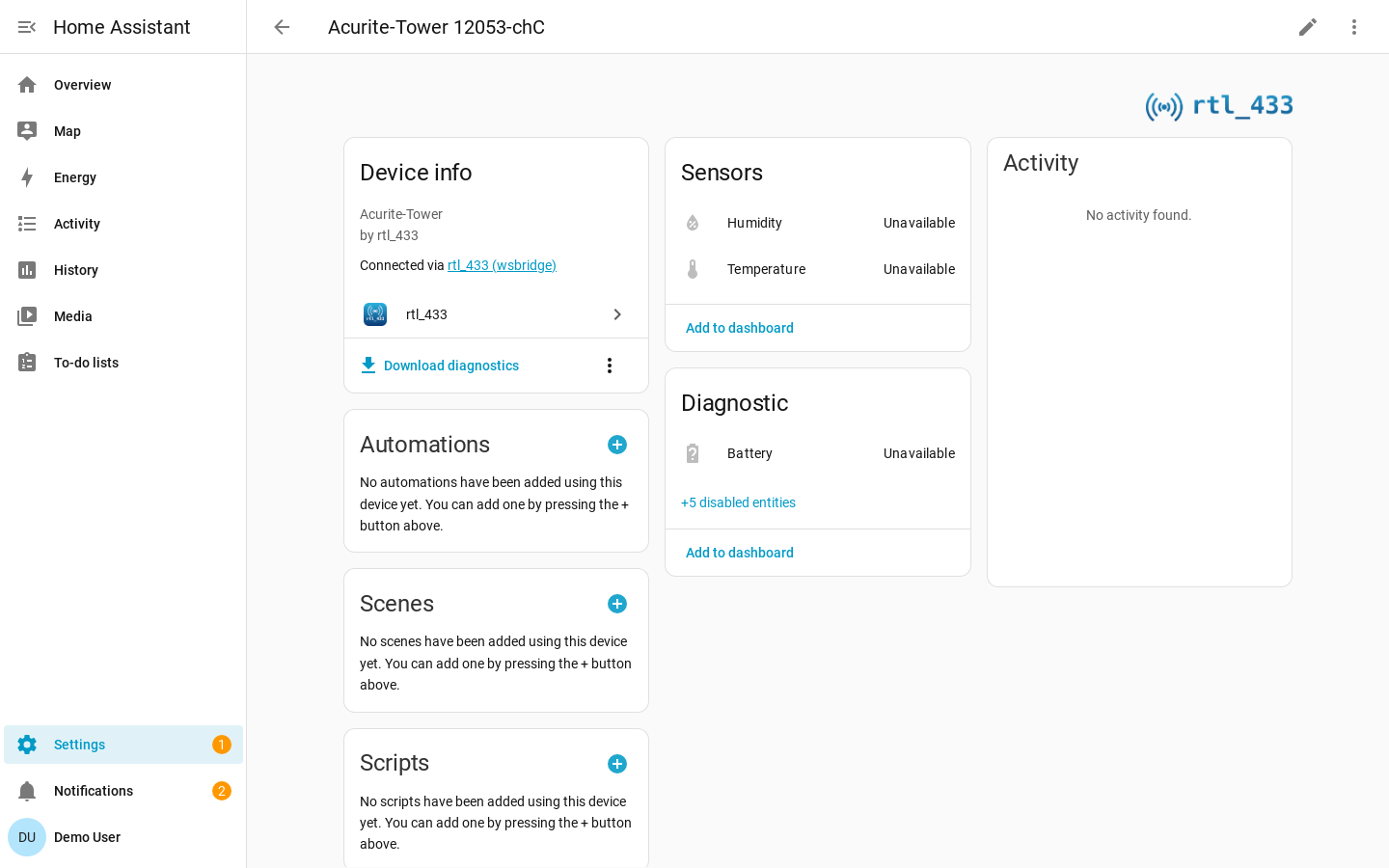
Availability
RF devices announce their presence only by transmitting, so the integration uses
a silence-based availability model. If no event for a device arrives within its
availability timeout, its entities become unavailable.
Transmit Cadences
How long a device can reasonably stay silent depends on the device type.
| Device type | Typical behavior |
|---|---|
| Periodic weather, temperature, soil, and air-quality sensors | Transmit on a regular cadence. |
| Door/window contacts, motion/PIR, buttons, doorbells, and security sensors | Transmit on events, sometimes with an occasional heartbeat. |
| Generic EV1527 door/PIR devices and parked TPMS sensors | May have no heartbeat and stay silent for days. |
Periodic devices use finite timeouts. Event-driven devices default to never expiring because a long silence is normal and does not imply failure.
Hub Connection
Silence only means something while the integration is listening. If the connection to the rtl_433 server drops, no events can arrive for any device, so a device's last reading says nothing about whether the device is still there.
When the connection to the rtl_433 server drops, every device behind that hub is
marked unavailable straight away, regardless of its own timeout — including
event-driven devices that never expire on silence, and their Last seen
sensors. There is no grace period: while the socket is down the integration
cannot hear the radio at all, so continuing to show the last reading would
present stale data as current. This is the same behavior an MQTT device gets from
an availability topic and a last-will message, and what Home Assistant
integrations do generally when a connection to a hub is lost.
The devices come back as soon as the connection is re-established; their values
are the last ones received, and the usual silence timeouts resume from there. A
brief drop therefore shows up as a brief unavailable — an honest one, because
during it the integration genuinely was not listening.
If you want an automation to tolerate short blips, condition it on the hub's
Connectivity binary sensor with a for: delay rather than reacting to each
device going unavailable.
The separate rtl_433 server unreachable repair issue is debounced: it waits 90 seconds before raising, so a routine server restart does not produce a notification even though the entities reported the outage immediately.
event entities (buttons, doorbells, remotes) go unavailable with everything
else. This matches Zigbee2MQTT, whose event entities carry the bridge-state
availability topic alongside the per-device one, and Home Assistant's own Shelly
and ESPHome integrations. Use the event.received trigger rather than a plain
state trigger: it ignores transitions out of unavailable, so a reconnect never
replays a stale press.
One kind of entity is deliberately exempt:
- The hub's SDR controls (Gain, Sample rate, Frequency
correction, Hop interval, Conversion mode) stay available, because
they are settings you are writing rather than readings you are trusting. With
Manage SDR settings on — the default — these appear as
number/selectentities. Turning it off replaces them with read-only diagnostic sensors, and those are gated on the connection along with the hub's other diagnostic sensors (center frequency, frame counters, enabled decoders), whose values are fetched over HTTP and would otherwise freeze at whatever was last read.
The Connectivity binary sensor is the entity that reports the outage: it reads the socket state directly and stays available throughout. The Home Assistant log records the drop and the reconnect:
INFO  rtl_433 lost the connection to ws://rtl433.local:8433/ws; reconnecting, and marking all 12 device(s) ...
INFO  rtl_433 reconnected to ws://rtl433.local:8433/ws after 184s
Timeout Sources
The effective availability timeout is resolved in this order:
- Per-device override from Device settings.
- Hub default from Hub settings, if set.
- Device-class default.
- 600 second fallback.
Set a timeout to 0 to make a device never expire. This is already the automatic
default for event-driven devices.
Restart Behavior
On Home Assistant restart, the last known states are restored first. The timeout then runs from the restart time, and entities flip to unavailable only after the restored silence window elapses without a fresh event.
Last Seen Sensor
Every device gets a diagnostic timestamp sensor named Last seen. It reports when the device was last heard from and restores its previous value across restarts.
Last seen is enabled by default for event-driven devices because they never expire and the timestamp is their freshness signal. It is disabled by default for periodic devices, whose availability already conveys freshness.
Unlike measurement sensors, Last seen stays available after the device falls silent, so it can drive staleness automations. It does go unavailable while the hub connection is down, because the timestamp then only records when the integration stopped listening.